Blainville’s beaked whale
Mesoplodon densirostrisBlainville, 1817
Named for its incredibly dense jawbone, the densest bone known in the animal kingdom. Blainville’s beaked whales live in warm, deep waters and are regularly recorded around Madeira and the Azores.
- Baleia-de-bico-de-Blainville
Least Concern
IUCN Red List · global- LC
- NT
- VU
- EN
- CR
- EW
- EX
- EU Habitats Directive
- CITES II
- Military sonar
- Underwater noise
- Plastic ingestion
- Bycatch
01About the species
Blainville’s beaked whale is one of the most widespread species in the genus Mesoplodon, found in deep tropical and warm temperate waters worldwide.
Its scientific name, densirostris, means “dense beak”: its jawbone is the densest bone ever measured. In Portugal it is seen mainly around Madeira and the Azores.
02Population status
The species is listed as Least Concern, but there are few population estimates. Studies in the Canary Islands and Bahamas have found small, resident populations.
Its status in Portuguese waters is unknown, though it is one of the more frequently recorded beaked whales around Madeira.
03Appearance
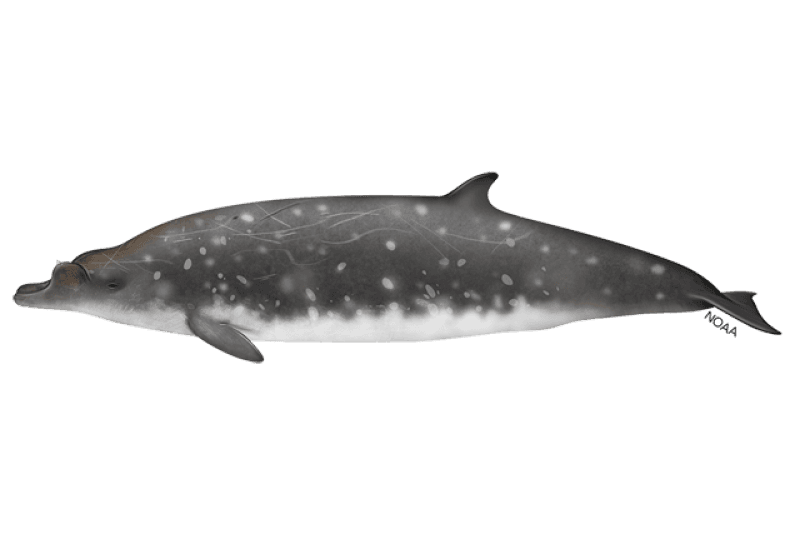
The lower jaw arches sharply upwards in adult males, with a large tooth erupting from the top of each arch — sometimes overgrown with barnacles. This gives the head a striking, almost horned profile.
They are dark blue-grey above and paler below, often covered with oval scars from cookie-cutter sharks and long scratches from other males.
04Behaviour & diet
They feed on small squid and deep-water fish, diving to depths of around 1,000 metres for nearly an hour, then making a series of shallower dives.
They are usually seen in small groups of three to seven and are quiet near the surface, which helps them avoid predators such as killer whales.
05Lifespan & reproduction
Little is known about their lifespan. Females are thought to reach maturity at around 9 years and give birth to a single calf every three years or so.
Calves are about 2 metres long at birth.
06Threats
Like other beaked whales, Blainville’s beaked whales are very sensitive to military sonar and have been involved in sonar-related mass strandings.
Plastic ingestion and occasional bycatch in fisheries are also recorded.
- EU Habitats Directive — Annex IV
- CITES — Appendix II
07Scientific classification
- KingdomAnimalia
- PhylumChordata
- ClassMammalia
- OrderArtiodactyla
- InfraorderCetacea
- ParvorderOdontoceti
- FamilyZiphiidae
- GenusMesoplodon
- SpeciesMesoplodon densirostris
Spotted a blainville’s beaked whale?
Every record helps researchers track populations along our coast.