Blue whale
Balaenoptera musculusLinnaeus, 1758
The largest animal that has ever lived. Every spring, blue whales pass through the Azores and Madeira on their way to northern feeding grounds, offering some of the best chances in Europe to see them.
- Baleia-azul
Endangered
IUCN Red List · global- LC
- NT
- VU
- EN
- CR
- EW
- EX
- EU Habitats Directive
- CITES I
- Bonn Convention
- Ship strikes
- Underwater noise
- Entanglement
- Climate change
01About the species
Blue whales can reach 30 metres and weigh as much as 150 tonnes — heavier than any dinosaur. Their heart alone is the size of a small car, and their calls are among the loudest sounds made by any animal.
They are found in every ocean, usually far offshore. In Portugal they are most often seen in the Azores, where they pause during their spring migration to feed on krill swarms, and less often around Madeira and off the mainland.
02Population status
Industrial whaling in the 20th century killed over 350,000 blue whales, reducing some populations by more than 99%. Since full protection in 1966 they have slowly recovered, and the species is now listed as Endangered.
The North Atlantic population is estimated at a few thousand animals. Photo-identification shows that some individuals seen in the Azores are later recorded off Iceland and Norway.
03Appearance
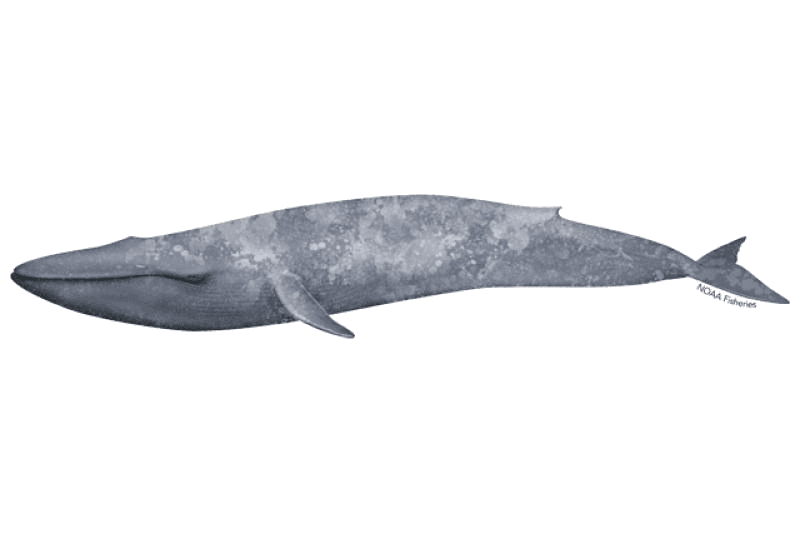
Blue whales are long and streamlined, with a broad, U-shaped head and a mottled blue-grey skin that looks pale turquoise under water. The dorsal fin is tiny and set far back.
Their blow is tall and column-shaped, reaching 9 metres. When diving they often show their broad tail flukes. Diatoms on the skin can give the belly a yellowish tinge, earning them the old name “sulphur-bottom”.
04Behaviour & diet
Blue whales feed almost exclusively on krill. Each lunge engulfs a volume of water larger than the whale itself, and an adult can eat up to 4 tonnes of krill a day during the feeding season.
They are usually solitary or travel in pairs. Their low-frequency calls can travel hundreds of kilometres under water and are thought to play a role in communication and navigation.
05Lifespan & reproduction
Blue whales are thought to live 70–90 years. Females reach maturity at 5–15 years and give birth every two to three years after a gestation of about 11 months.
Newborn calves are already 7 metres long and drink up to 380 litres of milk a day, gaining about 90 kg every day until weaned at six to eight months.
06Threats
Ship strikes are a major cause of death, especially where shipping lanes cross feeding areas. Noise from ships, seismic surveys and sonar can mask their calls and disrupt behaviour.
Climate change threatens the krill they depend on, and entanglement in fishing gear, although less frequent than for smaller whales, also occurs.
- EU Habitats Directive — Annex IV
- CITES — Appendix I
- Bonn Convention (CMS) — Appendix I
- IWC commercial whaling moratorium
07Scientific classification
- KingdomAnimalia
- PhylumChordata
- ClassMammalia
- OrderArtiodactyla
- InfraorderCetacea
- ParvorderMysticeti
- FamilyBalaenopteridae
- GenusBalaenoptera
- SpeciesBalaenoptera musculus
Spotted a blue whale?
Every record helps researchers track populations along our coast.