Short-beaked common dolphin
Delphinus delphisLinnaeus, 1758
The most abundant cetacean in Portuguese waters. Fast, playful and often seen in large, splashing groups, common dolphins can be found year-round along the whole mainland coast and around the islands.
- Golfinho-comum
Least Concern
IUCN Red List · global- LC
- NT
- VU
- EN
- CR
- EW
- EX
- EU Habitats Directive
- CITES II
- Bonn Convention
- Bycatch
- Pollution
- Prey depletion
- Underwater noise
01About the species
The short-beaked common dolphin is one of the most widespread and abundant dolphins in the world. It lives in temperate and warm waters over the continental shelf and in the open ocean.
It is the cetacean most often seen off the Portuguese mainland, from Minho to the Algarve, and it is also common around the Azores and Madeira. Groups frequently approach boats to ride the bow wave.
02Population status
Globally, there are several million common dolphins, and the species is listed as Least Concern. Hundreds of thousands live in the north-east Atlantic.
Despite their abundance, high numbers die every year in fishing gear along the Atlantic coasts of Portugal, Spain and France, raising concern about the long-term sustainability of these losses.
03Appearance
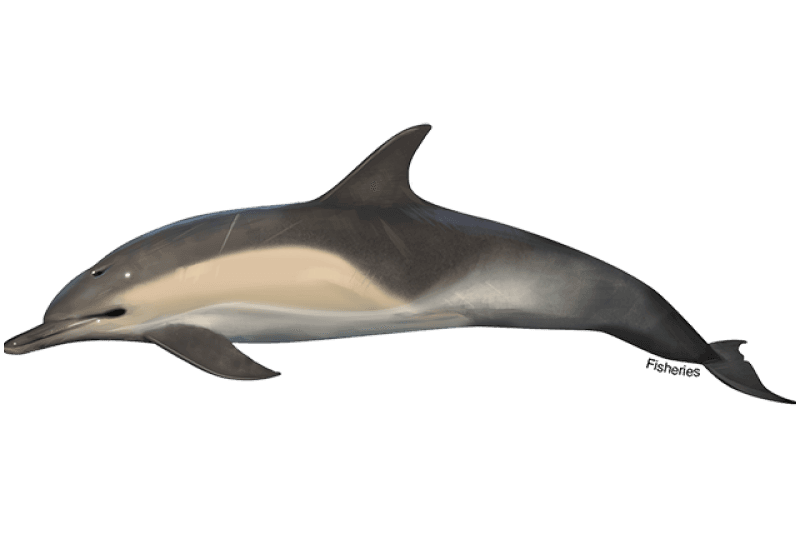
Common dolphins are slender, with a medium-length beak and a tall, curved dorsal fin. Their most distinctive feature is an hourglass pattern on the side: tan or yellowish in front, light grey behind, meeting below the dorsal fin.
The back is dark grey to black and the belly white. A dark stripe runs from the lower jaw to the flipper.
04Behaviour & diet
They feed on small schooling fish such as sardines, anchovies and horse mackerel, as well as squid. Groups cooperate to herd fish into tight bait balls, often attracting seabirds and other predators.
Common dolphins are highly social and energetic, living in groups of tens to hundreds — occasionally thousands. They often leap, bow-ride and travel at high speed.
05Lifespan & reproduction
Common dolphins live for around 25–35 years. Females reach maturity at about 8–10 years.
Gestation lasts 10–11 months, and calves are about 80–90 cm long at birth. Females give birth every two to three years.
06Threats
Bycatch is the main threat. Thousands of common dolphins die every year in trawls, gillnets and other fishing gear in the Bay of Biscay and along the Iberian coast.
Pollution, depletion of prey fish such as sardine, and underwater noise may add to this pressure.
- EU Habitats Directive — Annex IV
- CITES — Appendix II
- Bonn Convention (CMS) — Appendix II
- ASCOBANS
07Scientific classification
- KingdomAnimalia
- PhylumChordata
- ClassMammalia
- OrderArtiodactyla
- InfraorderCetacea
- ParvorderOdontoceti
- FamilyDelphinidae
- GenusDelphinus
- SpeciesDelphinus delphis
Spotted a short-beaked common dolphin?
Every record helps researchers track populations along our coast.