Risso’s dolphin
Grampus griseusG. Cuvier, 1812
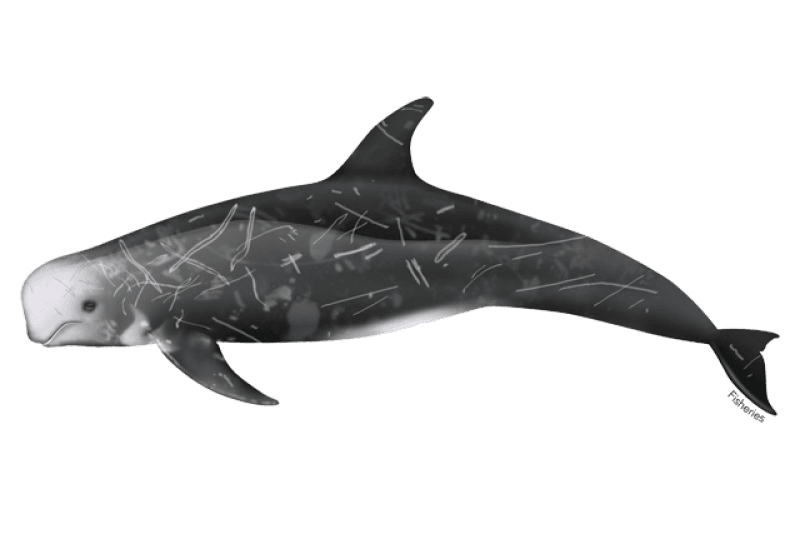
A large, blunt-headed dolphin that turns almost white with age as it accumulates scars. Risso’s dolphins are residents in the Azores and are also seen off the mainland and Madeira.
- Grampo
- Golfinho-de-Risso
Least Concern
IUCN Red List · global- LC
- NT
- VU
- EN
- CR
- EW
- EX
- EU Habitats Directive
- CITES II
- Bonn Convention
- Bycatch
- Underwater noise
- Plastic ingestion
- Pollution
01About the species
Risso’s dolphin is a large dolphin with a blunt, rounded head and no beak. It prefers deep waters along steep continental slopes and around oceanic islands.
In Portugal it is regularly seen in the Azores — where a resident population has been studied for years — and also off Madeira and the mainland.
02Population status
The species is widespread and listed as Least Concern, with several hundred thousand animals worldwide.
Photo-identification in the Azores has shown that many individuals are resident year-round and form long-term bonds.
03Appearance
Risso’s dolphins have a tall, dark dorsal fin and a stout body. A vertical crease runs down the front of the bulbous head.
Calves are grey, but adults become covered in white scratches from the teeth of other Risso’s dolphins and from squid. Old animals can look almost completely white.
04Behaviour & diet
They feed almost entirely on squid and octopus, hunting mainly at night along the continental slope.
Risso’s dolphins typically live in groups of 10–30 and often travel in tight lines. They rarely bow-ride, but may breach, spy-hop and slap their tails.
05Lifespan & reproduction
Risso’s dolphins can live for at least 35 years. Females reach maturity at around 8–10 years.
Gestation lasts 13–14 months, and calves are about 1.5 metres long at birth.
06Threats
Bycatch in gillnets and longlines occurs in parts of their range, and ingestion of plastic has been recorded in stranded animals.
Underwater noise from shipping and military sonar may affect their feeding and communication.
- EU Habitats Directive — Annex IV
- CITES — Appendix II
- Bonn Convention (CMS) — Appendix II
07Scientific classification
- KingdomAnimalia
- PhylumChordata
- ClassMammalia
- OrderArtiodactyla
- InfraorderCetacea
- ParvorderOdontoceti
- FamilyDelphinidae
- GenusGrampus
- SpeciesGrampus griseus
Spotted a risso’s dolphin?
Every record helps researchers track populations along our coast.