Short-finned pilot whale
Globicephala macrorhynchusGray, 1846
A deep-diving, sociable relative of the long-finned pilot whale. Short-finned pilot whales are among the most frequently seen cetaceans off Madeira, where some groups are resident year-round.
- Baleia-piloto-tropical
- Boca-de-panela
Least Concern
IUCN Red List · global- LC
- NT
- VU
- EN
- CR
- EW
- EX
- EU Habitats Directive
- CITES II
- Boat disturbance
- Bycatch
- Underwater noise
- Pollution
01About the species
The short-finned pilot whale lives in tropical and warm temperate waters worldwide. It is closely related to the long-finned pilot whale and very similar in appearance.
Madeira hosts both resident and visiting groups, making it one of the best places in Europe to see this species. It also occurs around the Azores, mainly in summer.
02Population status
The species is listed as Least Concern and is widespread, with several hundred thousand animals worldwide.
Long-term photo-identification in Madeira has identified island-associated groups that are seen year after year.
03Appearance
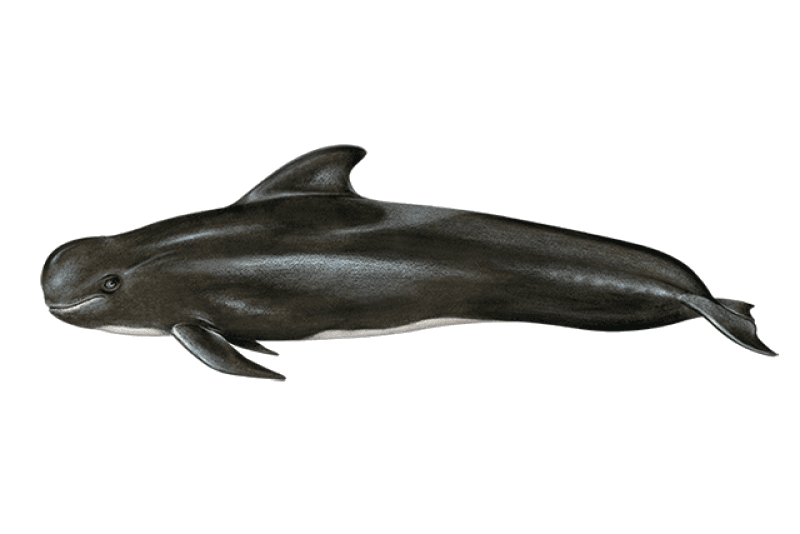
Short-finned pilot whales have a rounded, bulbous head, a broad, low dorsal fin set forward on the body and a dark grey to black body with a pale saddle and chest patch.
Their flippers are shorter than those of the long-finned pilot whale — around a sixth of the body length.
04Behaviour & diet
They feed mainly on squid, making fast, deep dives to 600–1,000 metres — sometimes described as the “cheetahs of the deep” for their high-speed sprints after prey.
They live in stable matrilineal groups of 10–30 animals and are often seen resting at the surface in tight groups, a behaviour known as logging.
05Lifespan & reproduction
Females can live for over 60 years and go through menopause, while males live up to around 45 years.
Gestation lasts about 15 months, and calves nurse for two years or more. Females give birth every five to eight years.
06Threats
Around Madeira, the growing whale-watching industry can disturb resting groups if boats approach too closely or too often.
Bycatch, underwater noise and pollutants are additional threats across their range.
- EU Habitats Directive — Annex IV
- CITES — Appendix II
07Scientific classification
- KingdomAnimalia
- PhylumChordata
- ClassMammalia
- OrderArtiodactyla
- InfraorderCetacea
- ParvorderOdontoceti
- FamilyDelphinidae
- GenusGlobicephala
- SpeciesGlobicephala macrorhynchus
Spotted a short-finned pilot whale?
Every record helps researchers track populations along our coast.