Sperm whale
Physeter macrocephalusLinnaeus, 1758
The largest toothed predator on Earth and the iconic whale of the Azores. Family groups live around the islands all year, diving to over 1,000 metres to hunt giant squid in the dark.
- Cachalote
Vulnerable
IUCN Red List · global- LC
- NT
- VU
- EN
- CR
- EW
- EX
- EU Habitats Directive
- CITES I
- Bonn Convention
- Ship strikes
- Plastic ingestion
- Underwater noise
- Entanglement
01About the species
The sperm whale is the largest toothed whale and has the biggest brain of any animal. Its enormous square head contains the spermaceti organ, a waxy reservoir thought to help produce and focus its powerful echolocation clicks.
Sperm whales live in deep waters worldwide. The Azores are one of the best places on Earth to see them: family groups of females and young are present year-round, while large adult males visit from higher latitudes.
02Population status
Sperm whales were hunted intensively for their oil — including from small open boats in the Azores until 1987. The global population is now estimated at several hundred thousand, and the species is listed as Vulnerable.
Long-term photo-identification in the Azores has catalogued thousands of individuals and shows that many family units return to the islands year after year.
03Appearance
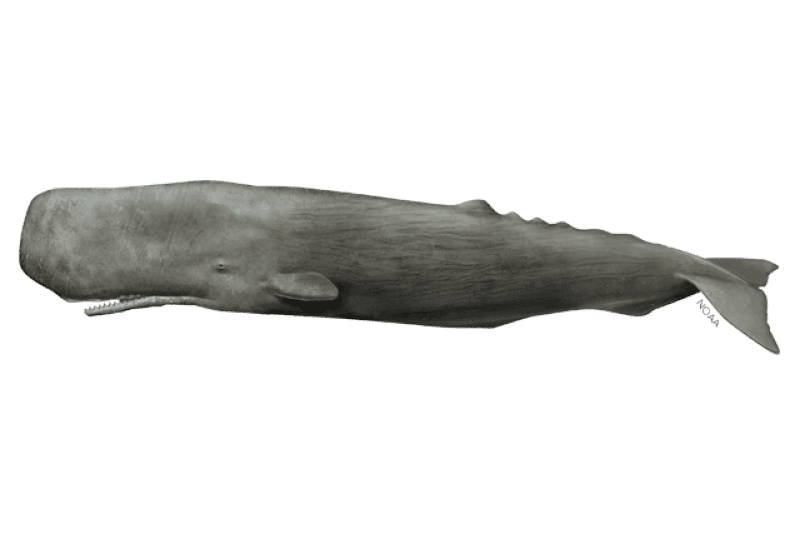
Sperm whales are dark brownish-grey with wrinkled, prune-like skin behind the head. The head makes up about a third of the body, and the narrow lower jaw carries 18–26 pairs of large conical teeth.
Instead of a dorsal fin there is a low hump followed by a series of knuckles. The single blowhole sits at the front left of the head, producing a distinctive bushy blow angled forward and to the left.
04Behaviour & diet
Sperm whales feed mainly on deep-water squid, including giant and colossal squid, as well as fish. They routinely dive to 400–1,200 metres for 45 minutes or more, and can reach depths beyond 2,000 metres.
Females and young live in stable matrilineal family units that babysit each other’s calves. They communicate with patterned click sequences called codas, and different clans in the Atlantic use different coda “dialects”.
05Lifespan & reproduction
Sperm whales live for 60–70 years or more. Females reach maturity at about 9 years, while males do not breed successfully until they are in their late twenties.
Gestation lasts 14–16 months, and calves nurse for two years or longer. Females give birth only every four to six years, so populations recover very slowly.
06Threats
Ship strikes are a significant cause of death, especially around ports and in areas with high-speed ferries. Sperm whales are also known to swallow plastic and fishing gear, which can block the stomach.
Noise from shipping, seismic surveys and military sonar can interfere with their echolocation, and they are occasionally entangled in fishing gear.
- EU Habitats Directive — Annex IV
- CITES — Appendix I
- Bonn Convention (CMS) — Appendix I & II
- IWC commercial whaling moratorium
07Scientific classification
- KingdomAnimalia
- PhylumChordata
- ClassMammalia
- OrderArtiodactyla
- InfraorderCetacea
- ParvorderOdontoceti
- FamilyPhyseteridae
- GenusPhyseter
- SpeciesPhyseter macrocephalus
Spotted a sperm whale?
Every record helps researchers track populations along our coast.