Striped dolphin
Stenella coeruleoalbaMeyen, 1833
A fast, acrobatic dolphin of offshore waters, with elegant dark stripes along its sides. Striped dolphins are seen off the Portuguese mainland and around both archipelagos, often leaping high out of the water.
- Golfinho-riscado
Least Concern
IUCN Red List · global- LC
- NT
- VU
- EN
- CR
- EW
- EX
- EU Habitats Directive
- CITES II
- Bonn Convention
- Bycatch
- Pollution
- Disease
- Underwater noise
01About the species
The striped dolphin lives in warm temperate and tropical waters around the world, usually beyond the continental shelf.
In Portugal it is found off the mainland — more often in deeper, offshore waters — and around the Azores and Madeira. It is also one of the species that most often strands on the Portuguese coast.
02Population status
With around two million animals worldwide, the species is listed as Least Concern. Hundreds of thousands are estimated to live in the north-east Atlantic.
Outbreaks of morbillivirus have caused mass die-offs in the Mediterranean, and high pollutant loads may increase vulnerability to disease.
03Appearance
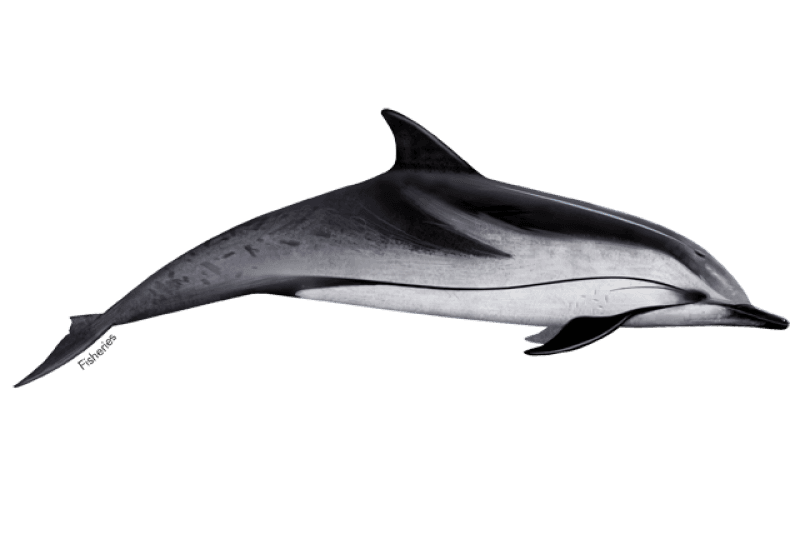
Striped dolphins have a slender body and a moderately long beak. A dark stripe runs from the eye along the side to the base of the tail, with a second, shorter stripe from the eye to the flipper.
A pale “shoulder blaze” sweeps up from the flank towards the dorsal fin, making the species easy to identify when it leaps.
04Behaviour & diet
They feed on small fish, squid and crustaceans, diving to depths of 200–700 metres along the continental slope.
Striped dolphins usually live in groups of 25–100 animals. They are highly acrobatic, performing high leaps, somersaults and a fast “roto-tailing” spin.
05Lifespan & reproduction
Striped dolphins can live for over 50 years. Females reach maturity at around 9 years.
Gestation lasts about 12 months, and calves are about 1 metre long at birth. Females give birth every three to four years.
06Threats
Bycatch in drift nets, purse seines and trawls is a significant threat. Pollutants such as PCBs accumulate in their tissues and may weaken their immune system.
Disease outbreaks and underwater noise are additional pressures.
- EU Habitats Directive — Annex IV
- CITES — Appendix II
- Bonn Convention (CMS) — Appendix II
07Scientific classification
- KingdomAnimalia
- PhylumChordata
- ClassMammalia
- OrderArtiodactyla
- InfraorderCetacea
- ParvorderOdontoceti
- FamilyDelphinidae
- GenusStenella
- SpeciesStenella coeruleoalba
Spotted a striped dolphin?
Every record helps researchers track populations along our coast.